Reference: Physical Review Letters 137, 134001 (2026) 

Abstract:
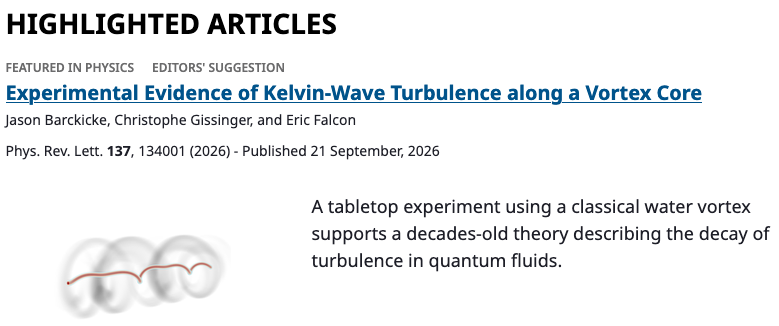
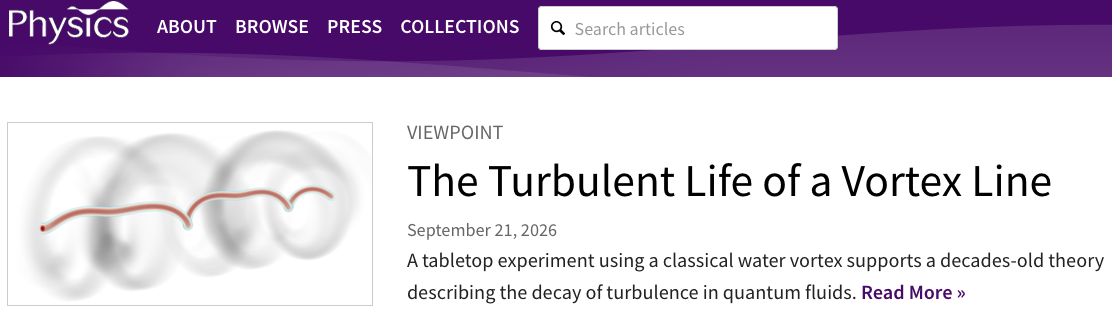
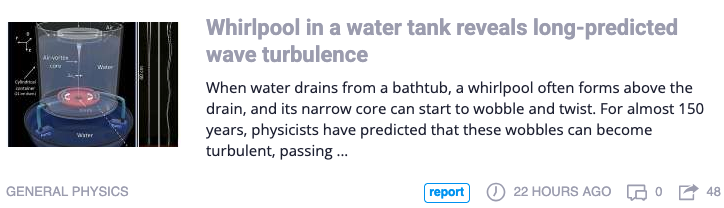
Wave turbulence is a regime of interacting nonlinear waves occurring in most physical systems. Kelvin waves are helical distortions that propagate along vortex filaments and are believed to play a central role in quantum turbulence up to atmospheric vortices. Yet, Kelvin wave turbulence has remained inaccessible to direct experimental observation. Here, we report the first direct experimental observation of Kelvin-wave turbulence along a single vortex filament in a classical fluid under controlled conditions. Using high-resolution spatiotemporal measurements, we resolve Kelvin-wave dynamics over a broad range of scales and obtain wave-amplitude spectra consistent with the predicted weak-turbulence cascade. We identify six-wave resonant interactions as the mechanism driving this energy transfer, providing direct experimental support for a long-standing prediction of weak-turbulence theory. These results establish an experimental platform for investigating energy transport along vortex filaments, with broader implications for both classical and quantum turbulent systems.
 in Allatra Media (Sept. 25, 2026)
"A Whirlpool in a Water Tank Gives Physicists a Way to Watch Wave Turbulence" (by Oli Kotyk - see also PDF )
in Allatra Media (Sept. 25, 2026)
"A Whirlpool in a Water Tank Gives Physicists a Way to Watch Wave Turbulence" (by Oli Kotyk - see also PDF )  in PhysOrg (Sept. 24, 2026)
"Whirlpool in a water tank reveals long-predicted wave turbulence" (by Sam Jarman - see also PDF )
in PhysOrg (Sept. 24, 2026)
"Whirlpool in a water tank reveals long-predicted wave turbulence" (by Sam Jarman - see also PDF )  in Physics 19, 118 (Sept. 21, 2026)
"The Turbulent Life of a Vortex Line" (APS viewpoint by A. Baggaley - see also PDF )
in Physics 19, 118 (Sept. 21, 2026)
"The Turbulent Life of a Vortex Line" (APS viewpoint by A. Baggaley - see also PDF )