A few words about imaging of fields of oriented fibers
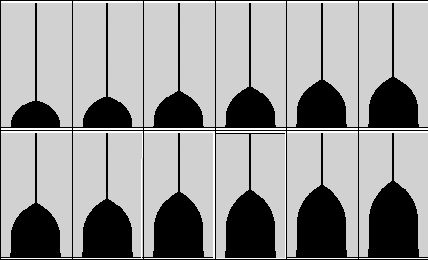
|
A few words about imaging of fields of oriented fibers |
||
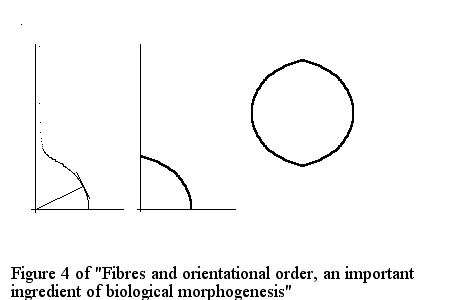
| Some time ago, I proposed with Tomoko watanabe (at that time she was working with Frank Constantini at Columbia), that the directions of growth of chondrogenic condensations (which eventually form bones), were selected by the anisotropy of fibers distribution. Singularities of growth would actually be associated to singularities of the pattern of fibers (topological singularities, such has hedge-hogs or target patterns). The presence of singularities would be (is actually) associated to a variation of surface tension, which would select in the physicist's sense, the direction s of outgrowth. These directions would be analogous to the corners of the crystals, in crystal science. The image here to the right explains the principle. If a surface, apparently uniform, is in fact fibred, it will tend to push out a tip in the direction of the axis of symmetry of the fiber distribution. (This calculation is performed with the wulff construction, for the experts). | |
|
| This phenomenon originates in the variation of surface tension, as a function of fiber density, and of orientation vector, say N, in the surface. The energy of a fraction dA or area, depends locally on the drawing of the fiber pattern. (there exist energy terms coming from bending, splay or twist of N). The plate to the right shows how the tip is calculated, forming a lemon like or a turnip like, simulated contour. | |
|
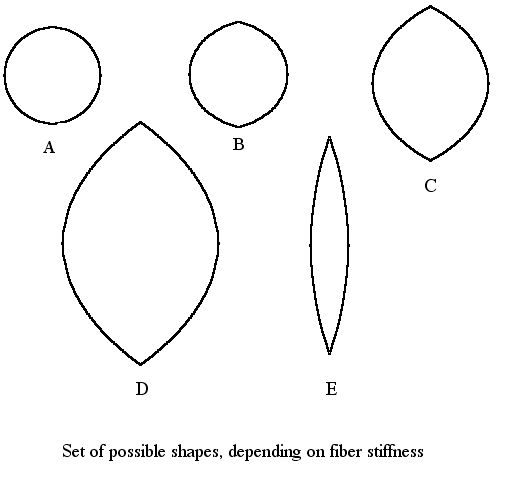
| Similar calculation of equilibrium shapes, for diffferent values of the tension of the fibers. | |
|
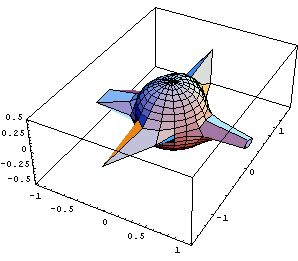
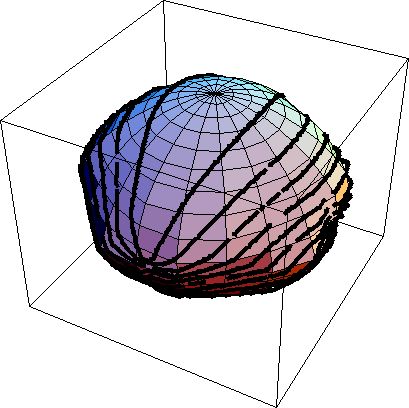
| However, the topology of the lines can be more complex than simply a meridian or a parallel winding. The figure here shows the energy surface of a sphere wound like a tennis ball. | |
|
| And now, the calculation of the corresponding deformed surface, in equilibrium with the pattern of tension. The surface is certainly not round, and there exist features (bumps, or flat facets) associated to the singularities of the pattern of fibers. | |
|
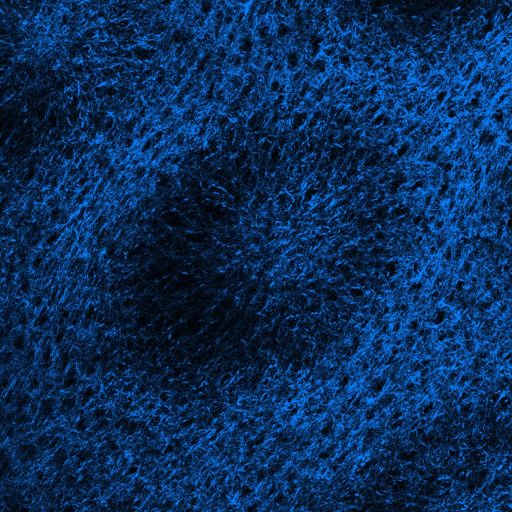
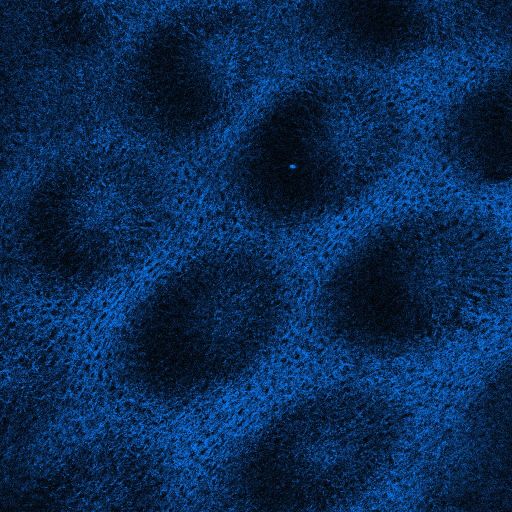
| Now, tehse concepts suggest that it is important to look at the fiber patterns in condensations of living material, especially if they tend to grow or portrude outwrads in specific directions. One popular model is that of chondrogenic condensations of chicken skin (feather bud). this buds tend to point out regularly and steadily in one and a single direction. Anyone knows, or should know, that phaners, like feathers, nails, scales are densely fibered, and it is obvious from simple inspection, that the backbone of a feather is fibered in the dircetion of its shaft. If you once played at writing with a goose feather, you have certainly noticed it. We assumed that the fiber order (the tissue orientation in-plane) was intimately linked to the growth direction. This is why, together with Olena Boryskina, Yann Le Grand and Christophe Odin, we went to see the eraly chondrogenic condensations, with their newly developed Second Harmonic Generation microscope. SHG is a rescattering of light which occurs inside polar molecules, such as Collagen type I. By associating a confocal microscope with a porper stimulating laser, one can image a contrast related to molecular orientation. | |
|
| When one images with this microscope the feather buds, which are fibroblasts condensations, one clearly sees very well organized fiber fields. The fibers are radial inside the buds, and parallel to the dorsal axis in between the buds. | |
|
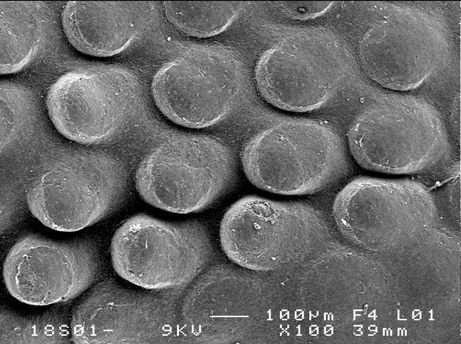
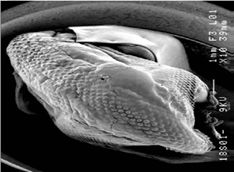
| Scanning electron microscopy of very early feather buds on the back of a chicken (circa 10 days of development, image obtained by O. Boryskina, and P Le Lannic). | . |
|
| Global view of the dorsal area of a chicken | |
|
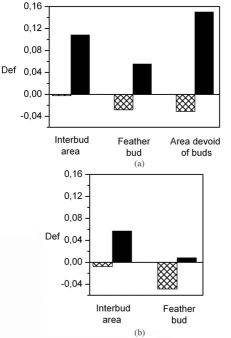
| We measured by tonometry the mechanical properties of the buds. The bud is in effect stiffer than the surrounding tissue. These measurements are extremely difficult to perform due to the curvature of the area around and on the bud (mexican hat profile). | |
|
| Retour à la page de présentation-Back to front page | ||