A few words about Aurelia Aurita

|
A few words about Aurelia Aurita |
||
| When I was in Britanny, I started to collaborate with the Cité de la Mer in Cherbourg. I ow a big acknowledgement to Pierre-Yves ouis and his staff in Cherbourg for their kind help. | |
|
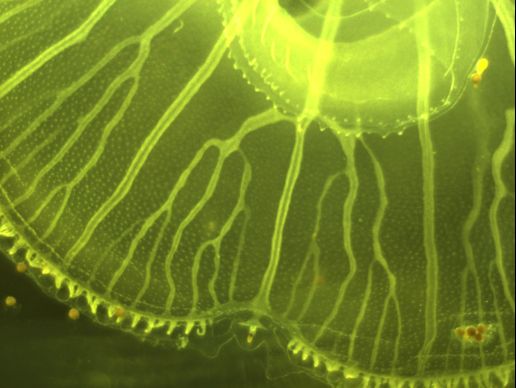
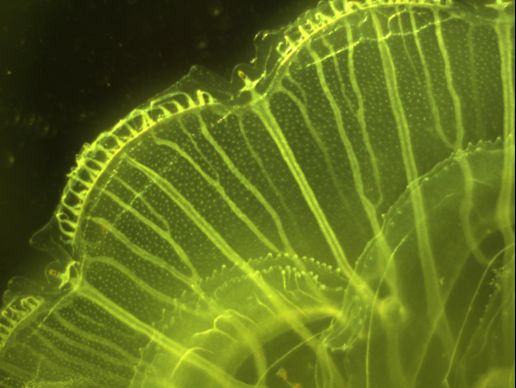
| I am interested in the pattern of vessels inside this jelly fish. It is quite hierarchical. The pattern seems to branch off dichotomously in aregular fashion, somewhat fractal-like. Nevertheless, it should be a very "primitive" animal. It does not have blood , but rather sea water (mixed with some gastric acids). It has vessels, sort of : veins and arteries radiate outwrads and inwards along the bell. We see here the arteries, which are the vessels with no side branches, radiating from the center and towards the rim. The veins are the vessels with branches. The arteries carry an eye at the end. There are generally 8 such eyes, sometimes 16, and even 32. Sometimes fewer than 8. | |
|
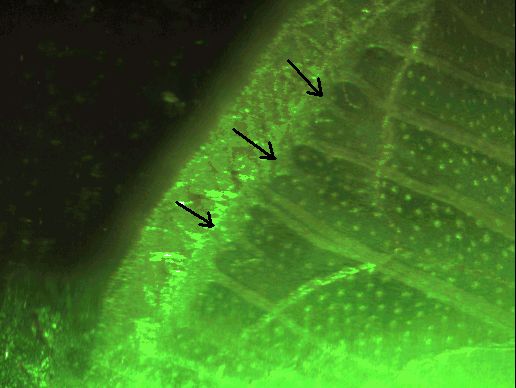
| While studying finely the development of the jelly fish, I realized that the vessels form by the edge. Actually, new buds appear at the rim, and progress centripetally, and they bow towards previous vein, where they finally reconnect. All sprouts nucleate half-way between previous vessels in the hierarchy. | |
|
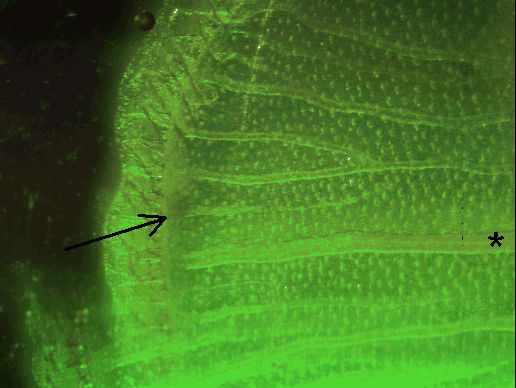
| On this image we see the tip of a newly formed vein, bowing towards a vein higher in the hierarchy, and not towards an "artery", which is the bigger vessel in the bottom of the image (star). | |
|
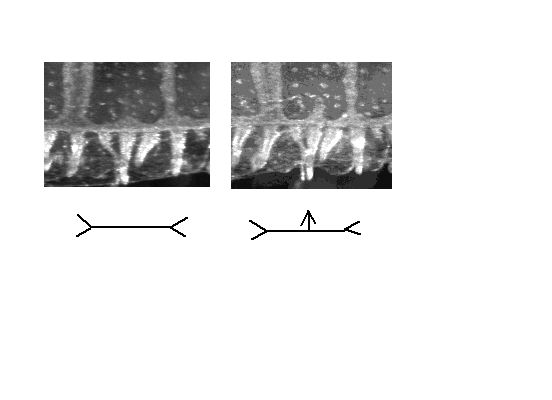
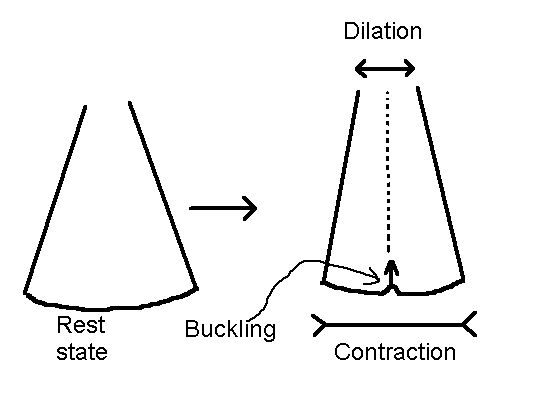
| By immobilizing the jellyfish in adapted beakers, we can obtain much weaker beats of the bell. It is then possible to observe the "sprouts" nucleation, along the bell. Sprouting seems to be associated to buckling of the edge. | |
|
| The mechanism of sprouting may thereofre be related to non-linear phsyics of folding (von karman buckling). This would explain naturally the very primitive origin of these tubes, they are related to phsycis, not to some evolved pathway. The navigation of the sprouts and maybe even the reconnection, might be self-organized by the stress field. | |
|
| Following the transfer of my lab to Paris, we plan to restart these experiments here in Paris (MSC). Annemike Cornelissen is the one who works now most actively on this topic. She has installed tanks of sea water etc. The picture to the right shows the new lab. | |
|
| We have done a presentation at the FASEB meeting on this topic. | ALIGN=Middle> | |
| Retour à la page de présentation-Back to front page | ||