|
HERE IS A GALLERY OF INTERESTING IMAGES, AND IMAGES RELATED TO HYSTORY OF MORPHOGENESIS (considered as a discipline) |
|
You may find these images, among many others, in my books.
|
|
Arbres de pierre (Flammarion, 1998)
|
|
Des pieds et des mains (Flammarion, 2003) |
|
De l'oeuf ŕ l'éternité (Flammarion, 2006) |
La chose humaine (Vuibert, 2009, to appear) |
|
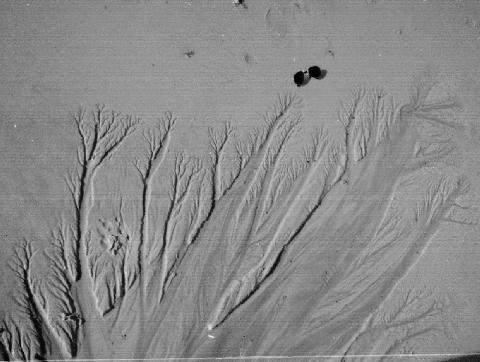
Traces left on the sand on a beach at Granville, where the tide recedes.
These are erosion channels, which grow upwards, as the see flows down. On this photo the water moves down. The lenses gives the scale. Millions of such patterns
are formed on the beach, twice a day. |
 |
| Traces left on planet Mars (image NASA, mission Viking).
It may be dendritic channels left by water, as it erodes the landscape.
The pattern of channels was once considered as a proof of the existence of water on mars (now they have direct evidence) |
 |
|
Graving from the book Herbarium diluvianum from Jean-Jacques Scheuchzer, circa 1700.
Scheuzer introduces, at that date, an experiment of viscous fingering explaining the formation of geological dendrites.
This experiment was performed again in 1950 by Saffman and Taylor.
Please note, on this engraving, that the plate contains both actual fossils of plants
and mineral dendrites. At that epoch, people ascribed the pattern of branching structures to some general "arbusculatum in modum"
mechanism of growth.
|
 |
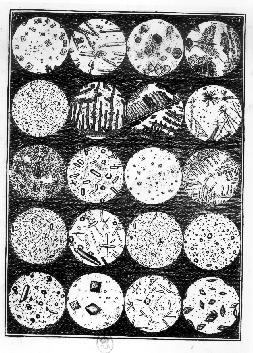
| Engraving from the book Prodromus Cristallographiae, from
Guillaume Capeller, circa 1700.Capeller was a friend of Scheuchzer.
The word "cristallography" was coined by Cappeller in this book.
In this plate, whatever appears in a round circle is actually a microscopy image (that was the convention at that time).
Many crystals in this plate are articifial ones, obtained by experimental art.
Such experiments of crystals growth were quite fashionable at that time (1700...). |
 |
|
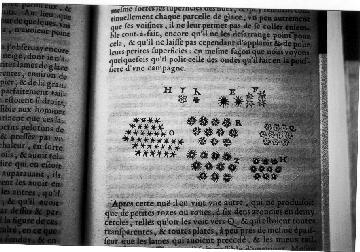
Plate from the Meteores (one application of the discours de la Méthode), of Descartes.
This plate shows snowflakes, as he observed them on 1637 february 25th, in Amsterdam.
His explanations about these patterns are complete rubbish, which is not quite a good point for the "method". |
 |
|
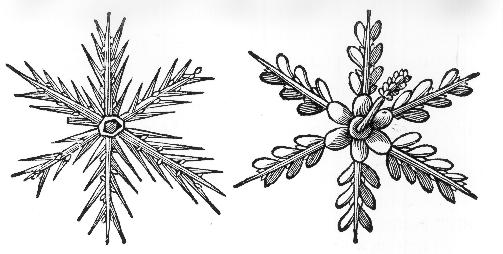
Plate from Histoires et Mémoires de l'Académie Royale des Sciences
(Note de Jean-Dominique Cassini 1692, Cassini was the royal astronomer appointed by the king.
The Observatoire de Paris was built for him, and ordered by Colbert, around 1670 to the architect Perrault).
Today, the Institut d'Astronomie de Paris is still in the gardens of the
Observatoire de Paris
in one of the most charming districts of Paris |
 |
|
Other images dealing with the history of cristallography (rather cool, but big files...)
Voir les images
|
Retour à la page de présentation-Back to front page |