|
Physics of head formation, coupling between deformation fields and cell texture. Link with evolution (evolutionary "constraints").
|
|
I am interested in the problem of head development, and, hence, in its evolution. I have noticed and shown
experimentally, that blood vessels
tend to align in the field of shear (in the yolk sac).
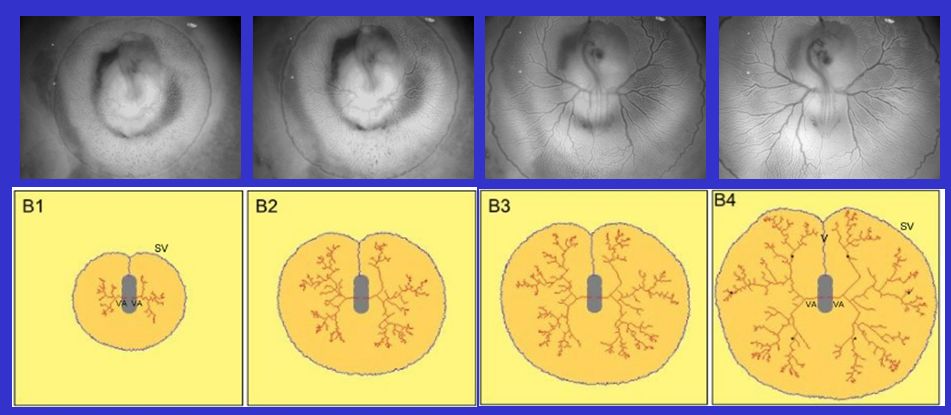
To the right, an image of blood vessels, as they progressively align
in the shear field. To the top, an in situ observation (film available upon request).
To the bottom, a calculation of a vascular tree by the model which I proposed with Thi-Hanh Nguyen. (T.-H. Nguyen et al., Phys Rev E 73, 061907 (2006) )
|  |
|
So I turned to study the brain, with Alia Al-Kilani
in order to see if these concepts could be transposed to the development of the tetrapod brain.
We noticed that at very early stages, the brain vesicle (which is a precursor of the brain tissues)
has a typical organisation quite similar to that of a yolk-sac.
The dynamics of formation is very much similar, except that it is a 3D shell, instead of a flat disk.
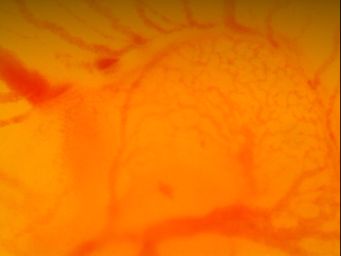
Vascular formation starts in the brain vesicle by a capillary lattice.
Here to the right, the lattice is faintly visible in the brain vesicle.
|
 |
|
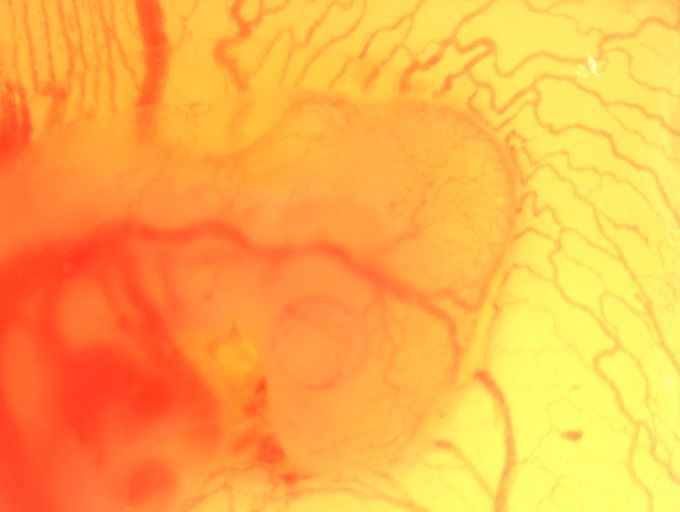
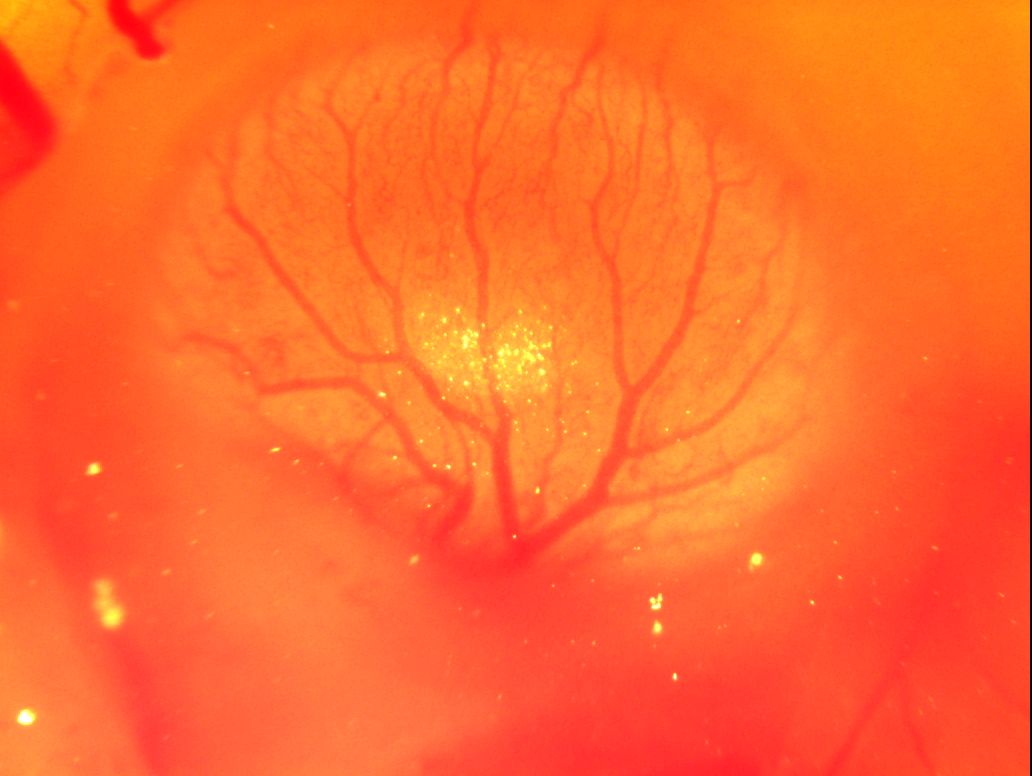
This lattice is progressively "matured" into a tree, much like in the yolk-sac. This tree is dipolar
on each side (hence a quadrupole), as in the yolk-sac.
These dipoles fan asunder, passing above the eyes, and reaching out towards the neck, prior to returning to the heart.
|
 |
|
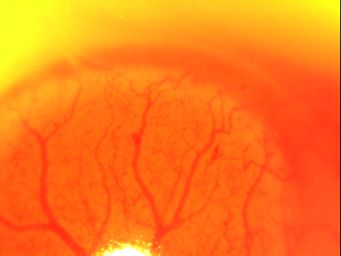
As the head "inflates", the vessels become more radial (monopolar).
|
 |
|
A bit later (by the 7th day)
|
 |
|
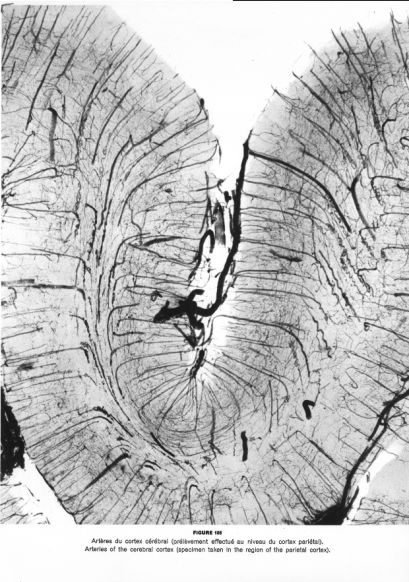
On the adult, the vessels seem to follow main stretch lines associated to viscous flow of the entire tissue
(not the flow inside the vessel).
These are more complex because of the folding. These deterministic paths appear very clearly on the china ink stainings of Professeur Duvernois (Emeritus, School of medecine Besançon, France).
|
 |
|
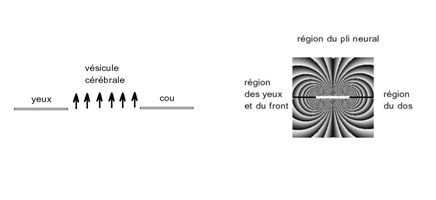
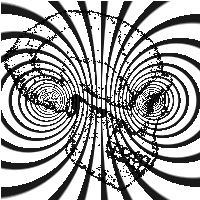
From these observations, on can derive a dynamic (deterministic) model of head formation. In this model, the head winds under the action of a dipolar flow
around two pivots, the ear duct and the horseshoe of the eyes.
This pattern originates in the flow of the neural crest, earlier on. It's all physics (hydrodynamics, actually; be carefull that it is not meant that embryos are a liquid. The point is that
tissues which deform at a constant rate under a chronic force have a "viscous material" behaviour)
|
 |
|
One can make a qualitative calculation (exact though, mathematically) by using Darcy's law.
|
 |
|
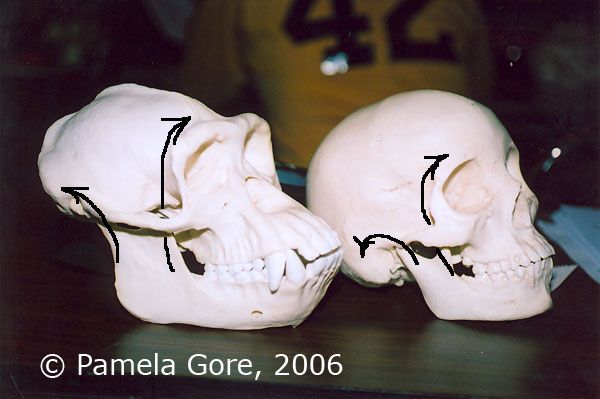
This model explains rather well the observations of Dambricourt-Malassé about the "cranio-facial contraction".
When comparing the skull of a chimpanzee, and one
of humans, one clearly sees this effect : growth (expansion) of the head is correlated with decrease of the
jaw (correlation in the sense of Darwin).
|
 |
|
The living tissue is so to speak blocked in this evolutionary pattern
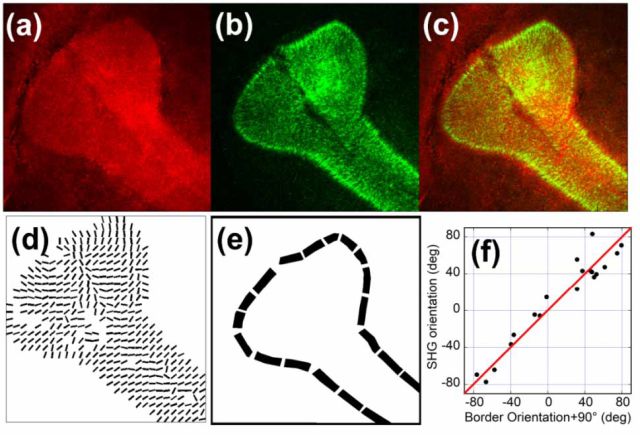
by the topology of the winding. In order to check this, we looked by Second Harmonic Generation at the field of fiber (collagen) orientation
in the neural crest as a stage where it is just forming, in a young embryo. We confirmed that the orientation field is
topologically related to the deformation field.
|
 |
|
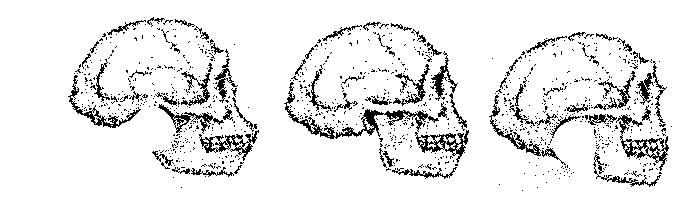
By playing the vortex ring one way or the other, on can produce deterministic evolutions, or retro-evolutions of a homo habilis skull.
|
 |
Brain explanation continues (gallery of early embryos brains)
| See the brains
| |
The quotation of the page : |
"If men use the atomic bomb for the 3rd world war, they will use sticks and clubs for the fourth
", Albert Einstein.
|
|
Retour à la page de présentation-Back to front page |