
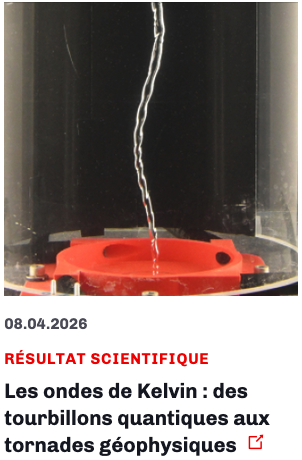
URL: https://www.nature.com/articles/s41567-026-03175-w
Abstract:
Kelvin waves are the most fundamental excitations that propagate along vortex lines, and they play a central role in the redistribution of energy and the stability of rotating flows. They are believed to underpin key processes in both classical and quantum turbulence, from the decay of vortex tangles in superfluid helium to dissipation mechanisms in atmospheric vortices. Despite their significance, quantitative observations of Kelvin wave dynamics that resolve their dispersion relation remain a challenging problem. Here, we experimentally characterize the propagation of Kelvin waves along a stable, controlled, and macroscopic vortex core and access their dispersion relation. Our spatiotemporal measurements, spanning nearly two decades in scale, reveal both helical bending modes and double-helix waves, which validate theoretical predictions for turbulent rotating flows. We also observe the statistics of temporal fluctuations of Kelvin waves and show how their dynamics are shaped by local vortex properties, such as vertical flow and excitation location. Our results provide quantitative insight into the mechanisms driving energy cascades in Kelvin wave turbulence, thus offering a classical analogue to quantum systems in which direct measurements remain inaccessible. Beyond this fundamental relevance, they also shed light on the dynamics of large-scale vortices, from intermittent tornado behaviour to the stability of aircraft wake vortices.
 Kelvin waves: from quantum vortices to geophysical tornadoes in CNRS Physics Scientific Results, April 08, 2026
  France TV: “Vortices” a science documentary on France 5 (scheduled for 2027). 90 min.
  La Recherche On the trail of Kelvin waves February 13, 2026 by J. Barckicke, E. Falcon C. Gissinger (in French)
  Sciences et Avenir
The art of setting vortices vibrating February 13, 2026 by P. Pajot (in French) (see also in PDF and video)
Sciences et Avenir
The art of setting vortices vibrating February 13, 2026 by P. Pajot (in French) (see also in PDF and video)  Kelvin waves: from quantum vortex to geophysical tornadoes in MSC Lab news (in French), March 11, 2026