 |
|
 |
Instabilities
(papers by our
group)
In granular layers:
We
report free-surface instabilities in a
deep bed of fine granular material
of irregular shape under vertical vibrations.
At low frequency of vibration, the
conical heap due to convective flow becomes
unstable above a critical amplitude of
vibration and acquires an azimuthal
dependence which makes the heap surface
corrugated. At even higher
amplitude, the heap is no longer stable and
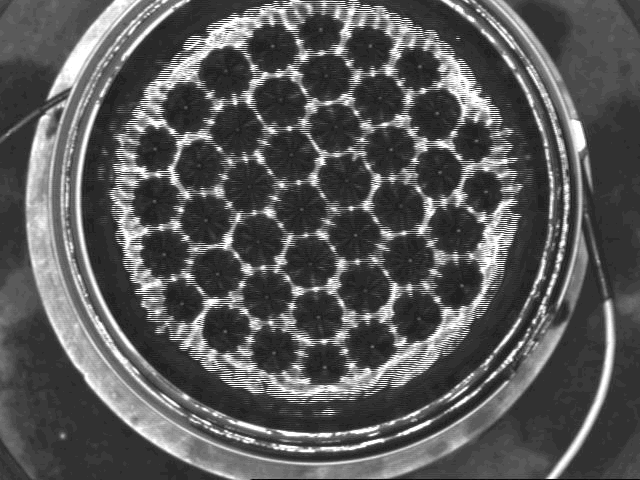
splits into small heaps on a
hexagonal lattice. At high frequency, we
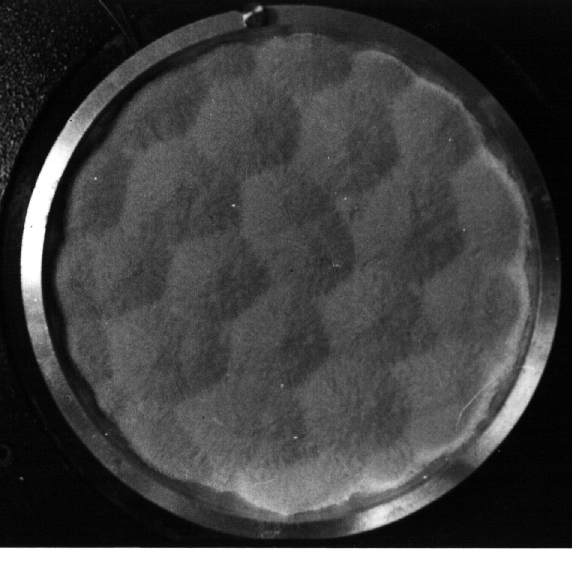
observe standing waves (stripes) at the same
frequency as the driving one. The
main mechanism of these instabilities can
be traced back to the presence of the
surrounding gas, since they vanish
under vacuum conditions.
Right (left) photo vizualised with a direct (strob) light. (see Paper) |
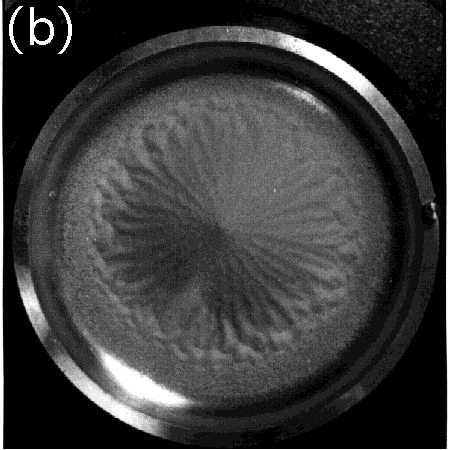
Heap Corrugation of a powder under vertical vibrations. (see Paper) |


The
shape of the convective cell within the granular heap
has been also studied (see
paper)
In
ferrofluids:
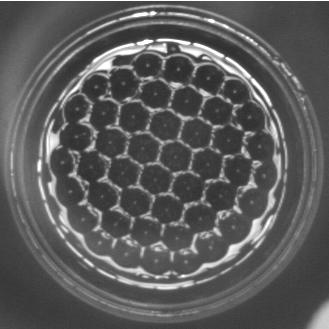
We report an
experimental study of the inhibition of the
instability generated by a magnetic field applied
perpendicularly to the surface of a magnetic fluid
(the Rosensweig instability), by vertical vibrations
of the fluid container. Our measurements are in
quantitative agreement with a simple analytical model
using the theory of Mathieu functions. Paper
Solid-solid friction:
An apparatus
has been built to measure the shear response of a
multicontact interface between flat-ended solid
bodies, rough at the micron scale. The
device makes use of inertia to apply a
steady sinusoidal shear force to a slider without
direct mechanical drive. Both elastic
compliance and damping losses are deduced from
the in-phase and out-of-phase components of the
submicronic shear displacement. The
resolution of the microslip detection is 1
nm. Apparatus design and operation are described, and
the application and limitation of the method are
illustrated by experimental results with a
polymer glass. Paper

- In mechanics:
Physica D: Nonlinear Phenomena 463, 134164 (2024)
Nonlinear dynamics of a hanging string with a freely pivoting attached mass
- In fluid:
- 12. F. Novkoski, E. Falcon & C.-T. Pham, 2021
-
Physical Review
Letters 127, 144504
(2021)
Experimental
Dispersion Relation of Surface Waves Along a
Torus of Fluid
- 11. F. Bonnefoy,
A. Tikan, F. Copie, P. Suret, G. Ducrozet,
G. Pradehusai, G. Michel, A. Cazaubiel, E.
Falcon, G. El & S. Randoux 2020

-
Physical Review
Fluids 5, 034802 (2020)
From modulation
instability to focusing dam breaks in water
waves
- 10.
C. Laroche, J.-C. Bacri, M. Devaud, T. Jamin &
E. Falcon 2019
Physical Review Letters 123, 094502 (2019) - Observation of the resonance frequencies of a stable torus of fluid
- 9. E. Falcon, J.-C. Bacri & C. Laroche, 2017
- Physical Review Fluids 2, 102601(R) (2017) - Rapid Communication Dissipated power within a turbulent flow forced homogeneously by magnetic particles
- 8.
T.
Jamin, Y. Djama, J.-C. Bacri & E.
Falcon 2016
Tuning the resonant frequencies of a drop by a magnetic field -
Physical Review Fluids 1,
021901(R) (2016) - Rapid Communication
7. T. Jamin, C. Py & E. Falcon 2011 
Instability of the origami of a ferrofluid drop in a magnetic field
Physical Review Letters 107, 204503 (2011)
- 6. F. Pétrélis, E. Falcon & S. Fauve 2000 Parametric stabilization of the Rosensweig instability.
European Physical Journal B, 15, 3 - 6 (2000)
In granular layers:
- 5.
Falcon, E., Castaing, B. &
Creyssels, M. 2005:
Propriétés électriques de la matière granulaire: Bruit et intermittence - Bulletin de la Société Française de Physique, 149, 6 - 9 (2005) (in french)
- 4. Falcon, E., Castaing, B. & Laroche, C. 2004 ``Turbulent'' electrical transport in Copper powders
Europhysics Letters 65, 186-192 (2004)
- 3. Kumar, K., Falcon, E., Bajaj, K. M. S., & Fauve, S. 1999 Shape of convective cell in Faraday experiment with fine granular materials
- 2. Falcon, E., Kumar, K., Bajaj, K. M. S. & Bhattacharjee, J. K. 1999 Heap corrugation and hexagon formation of powder under vertical vibrations.
Physica A , 270, 97-104 (1999)
Physical Review E, 59, 5, 5716-5720 (1999)
Solid-solid friction:
- 1. Baumberger,T. , Bureau, L., Busson, M., Falcon, E. & Perrin, B. 1998 An inertial tribometer for measuring micro-slip dissipation at a solid-solid multicontact interface.
Review of Scientific Instruments 69 , 6, 2416-2420 (1998)
home page